TL;DR: Google Maps is moving from simple lookup to conversational recommendation. That raises the pressure on your Google Business Profile, reviews, categories, photos, links, and website clarity. If your business information is weak, outdated, or inconsistent, Google Maps AI has less reason to recommend you. If you want to know what to fix first, start with a Find My Revenue Leaks.
Google Maps AI local business visibility just became a real issue for small businesses.
On March 12, 2026, Google announced two major Maps updates: Ask Maps and Immersive Navigation. For local businesses, Ask Maps is the bigger story. It lets people ask natural, detailed questions and get recommendations inside Maps. Google says Ask Maps pulls from information across more than 300 million places and more than 500 million contributors, and the feature is rolling out first on mobile in the U.S. and India. AP’s coverage also noted that Google would not say whether businesses may one day be able to pay for extra exposure in Ask Maps.
That matters because many small businesses still treat Google Maps like a digital phone book. It is not heading in that direction. It is heading toward recommendation. The old question was, “Are you listed?” The new question is, “Would Google recommend you for this exact need?”
If that makes you uneasy, good. It should. Weak profiles, weak reviews, unclear categories, thin service detail, and sloppy website signals are now bigger visibility leaks. This is exactly what we address in AI Search Ready and in our article on what AI Search Ready means in 2026.
What changed in Google Maps for local businesses?
Google Maps now has a stronger AI recommendation layer. Ask Maps lets users ask more complex, real-world questions in plain language, then get suggestions from Maps. That pushes local discovery away from simple keyword lookup and closer to intent-based recommendation.
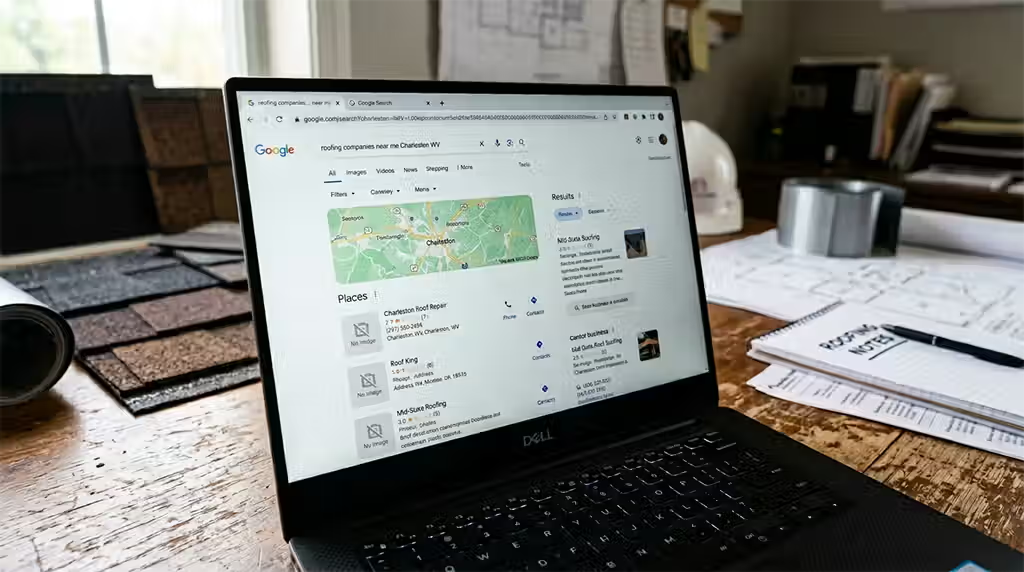
This is not a small UI tweak. It changes how a customer can search. Instead of typing “coffee near me,” they can ask for a quiet coffee shop with outdoor seating and short lines. Instead of typing “roofing company,” they can ask for the best option nearby for a specific need. Google is telling us, in plain sight, that Maps is becoming more conversational through Ask Maps.
For local businesses, that means Google has to understand what you do, where you do it, and why a buyer should trust you. If your profile is vague, outdated, or incomplete, you are giving Google less to work with.
Does Google Maps AI change local business visibility?
Yes. Google Maps AI changes local business visibility because it puts more pressure on relevance and trust, not just presence. You do not win just because you have a profile. You win when Google can understand your business clearly enough to match it to a buyer’s real question.
Google’s own Business Profile guidance still says local results are mainly based on relevance, distance, and prominence. Google also says that complete and accurate business information can help it better understand your business and match your profile to relevant searches. That point matters even more when search becomes conversational.
Google also says your primary and additional categories help connect your business to customer searches. If your category is too broad, wrong, or incomplete, Google may not understand your best fit. In an AI-driven Maps environment, that is not a minor mistake. It is a recommendation problem.
The same goes for business descriptions. Google’s guidance on business summaries on Google Maps makes it clear that business descriptions, editorial summaries, and review snippets all shape what a user sees. If your business description does not explain what you offer, what sets you apart, and what kind of buyer you serve, you are making Google guess.
The new pressure point is recommendation readiness
Most local businesses are still optimizing for visibility the old way. They want to rank. They want more views. They want to show up in the map pack.
That is not wrong. It is just incomplete.
The newer pressure point is whether your business is recommendation-ready. Can Google look at your profile, reviews, photos, links, business details, and website and feel confident putting you in front of a buyer with a detailed question?
That is where a lot of businesses break.
Some have a claimed Google Business Profile but weak categories. Some have reviews, but the reviews are thin and generic. Some have decent websites, but the site says one thing while the profile says another. Some have service pages, but the pages do not answer the real questions buyers ask. Some have traffic, but no clear next step. Those are all visibility leaks.
On our side, that is why we talk about clarity, consistency, and credibility so often. It is not branding fluff. It is the difference between getting surfaced and getting skipped. You can see that same theme across our digital marketing services and our article on The Follow-Up Gap. One problem is getting recommended. The next problem is turning that recommendation into a call or booking.
What signals help Google trust and recommend a local business?
The biggest signals are not mysterious. Google has documented many of them. The hard part is that most small businesses do not maintain them well.
First, profile completeness still matters. Google says complete and accurate business information helps it understand your business and match it to the right searches. Hours, services, service areas, contact info, and categories are not filler. They are core inputs.
Second, categories matter more than many owners think. Google says to choose a primary category that best describes your main business, then add additional categories when they are truly relevant. If your categories are weak, your relevance signal is weak.
Third, reviews matter. Google says reviews help your business stand out, and its ranking guidance says more reviews and positive ratings can help local ranking. Review text also gives Google more language to work with when it tries to understand what people consistently say about your business.
Fourth, photos matter. Google says photos and videos help complete your profile and make it more attractive to customers. Exterior photos help customers recognize your business. Interior, product, and service photos add context.
Fifth, action links matter. Google lets eligible businesses manage booking, ordering, menu, and other profile links. When someone is ready to act, friction matters. A business that makes the next step obvious is easier to convert.
Sixth, product visibility matters for retailers. Google says eligible merchants can showcase in-store products on Search and Maps. If a shopper asks Maps for a specific product nearby, this becomes a stronger part of your visibility story.
Last, your website still matters because it validates what your profile claims. Google’s documentation on AI features and your website says there are no special tricks required for AI features, but the usual SEO basics still matter. Google’s LocalBusiness structured data documentation and its guide on adding business details reinforce the same point: clear business details on your site help Google understand who you are.
What should a small business fix first for Google Maps AI visibility?
Start with the basics that remove the biggest contradictions first.
- Fix your core profile data. Make sure your business name, category, hours, service area, phone, website, and services are current and accurate. Google cannot recommend what it cannot trust.
- Tighten your categories and service detail. Your primary category should reflect your main business. Your services should be clear. Your description should explain what you do and who you help.
- Improve review quality, not just review count. Ask real customers for honest feedback. Use Google’s own review link or QR code tools to make the process easier. Then respond like a real business, not a robot.
- Add real photos. Show the outside, inside, team, work, products, and service experience. Buyers trust what they can see.
- Align your website with your profile. Your site should say the same things your profile says, but in more detail. That includes your services, service areas, trust signals, and next steps. This is why our WordPress Websites & Hosting work is built around clarity, proof, and conversion, not just design.
- Fix the conversion path. Getting recommended is not enough. If a buyer clicks through and has no clear next step, you still lose. That is where your AI Workforce and follow-up system come in. Speed still matters after visibility.
Why your website still matters if Google answers first
Your website still matters because Google needs a source of truth.
Google’s Search Essentials tell site owners to use words people actually search for, make links crawlable, and create helpful, reliable content. Google’s people-first content guidance says its systems are designed to reward content built to benefit people, not to manipulate rankings.
That fits exactly with where local visibility is heading.
Your website should explain your services clearly. It should show who you serve and where you work. It should answer common buyer questions. It should make contact easy. It should support the same facts your Google Business Profile presents. If your website confuses buyers, it also weakens your AI visibility story.
It also needs guardrails. We are direct about that in Our AI Guardrails. Humans lead. AI supports. No invented facts. No fake proof. No guessing. That matters because bad AI content can create more contradictions, not fewer.
What this means for local visibility in 2026
Google Maps is moving toward recommendation. Small businesses need to stop thinking like that is a future problem.
The businesses that win will usually be the ones that are easiest to understand, easiest to verify, and easiest to trust. Not the ones with the cleverest slogan. Not the ones posting random content three times a week. Not the ones with the loudest sales pitch.
If your business profile, reviews, website, and follow-up system are clean, aligned, and active, you give Google a stronger case to recommend you. If they are not, you are easier to skip.
That is the pressure. It is also the opportunity.
If you want a fast baseline of where you are strong, where you are leaking visibility, and what to fix first, request a Find My Revenue Leaks. If you already know the problem is costing you calls, book a Clarity Call.
Frequently Asked Questions
What is Ask Maps in Google Maps?
Ask Maps is Google’s new Gemini-powered conversational feature inside Maps. It lets people ask more detailed local questions in natural language and get recommendations back based on Maps data, reviews, and business information. Google announced it on March 12, 2026 in its official Maps update.
Will Google Maps AI change local SEO?
Yes. Google Maps AI raises the pressure on local SEO because it depends more on relevance, trust, and business clarity. Google’s own local ranking guidance still points to relevance, distance, and prominence, but conversational search makes weak business signals harder to hide.
Can I pay to rank better in Google Maps AI recommendations?
Not based on what Google says today. Google’s Business Profile help says there is no way to request or pay for a better local ranking, and AP reported that Google did not say whether ads may influence Ask Maps recommendations in the future.
What parts of my Google Business Profile matter most now?
The most important pieces are your core business details, categories, services, reviews, photos, and action links. Google’s support documentation ties these directly to local ranking, category relevance, review visibility, photos, and business links.
Does my website still matter if Google gives answers inside Maps?
Yes. Your website is still one of the clearest places to verify your services, locations, trust signals, and next steps. Google’s guidance on AI features and your website makes it clear that normal SEO best practices still matter for AI-driven experiences.
Go deeper: read our guide to AI Search Optimization in Charleston, WV and how we make your business the answer AI recommends.