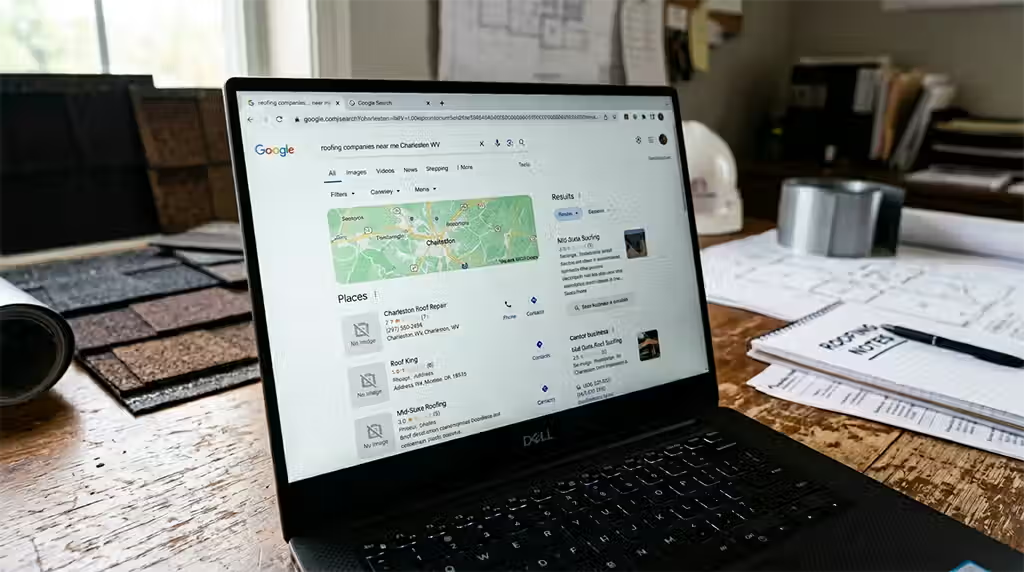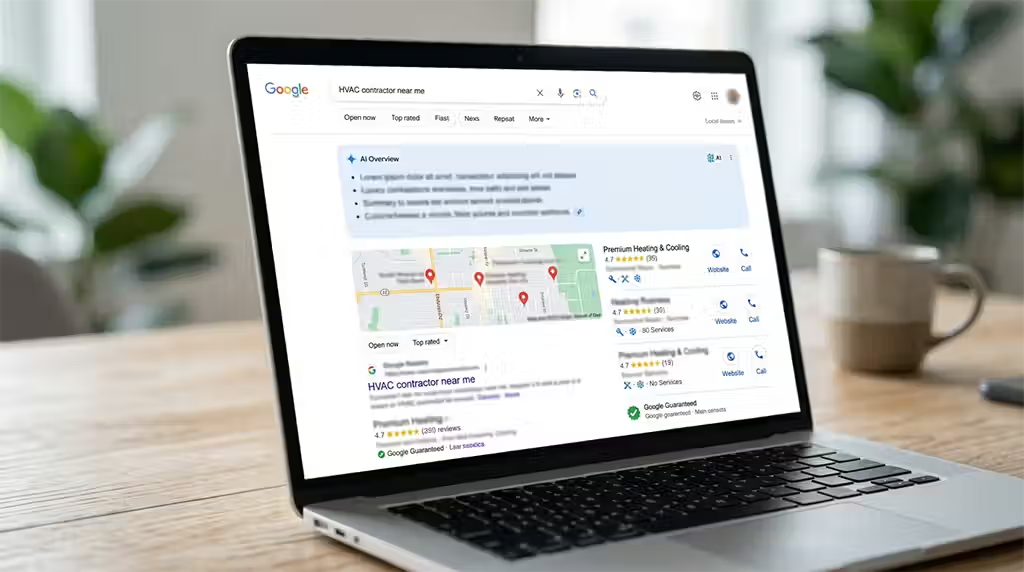
Most West Virginia local businesses do not get skipped because they are bad businesses.
They get skipped because they are hard to understand online.
That is the blunt truth.
A business may do great work, have loyal customers, and still look weak in search because the public signals are thin, inconsistent, or unclear.
That creates a problem.
People compare faster now. Search results include more summaries and recommendations. AI tools can influence who makes the shortlist before a buyer ever calls.
HubSpot explains that AEO focuses on two key strategies: content optimization and visibility across channels. In plain English, your content needs to be understandable, and your business needs consistent signals across the places buyers and search systems check.
For local businesses, this does not mean panic.
It means cleanup.
AI Search Cannot Recommend What It Cannot Understand
This is the core idea:
AI search cannot confidently recommend a business it cannot clearly understand.
If your business information is vague, scattered, outdated, or inconsistent, you are making the system work too hard.
That is not where you want to be.
Your online presence should answer the obvious questions fast:
- What do you do?
- Where do you work?
- Who do you serve?
- What problems do you solve?
- Why should someone trust you?
- What should they do next?
If those answers are not clear, your visibility suffers.
Problem 1: Your Website Is Too Vague
A lot of local business websites sound like they were written to avoid saying anything specific.
They use broad phrases like:
- quality service
- customer satisfaction
- experienced team
- full-service solutions
- reliable results
Those phrases may be true, but they do not explain much.
A stronger website says:
- what services you offer
- what locations you serve
- what type of customer is the best fit
- what the next step looks like
- what makes your process different
- what proof supports your claims
Clarity beats cleverness.
Problem 2: Your Service Pages Are Thin
A service page should not be a paragraph and a phone number.
It should help a buyer make a decision.
A strong service page should answer:
- What is the service?
- Who is it for?
- What problem does it solve?
- What does the process look like?
- What should someone expect?
- What related services matter?
- What questions do buyers ask before calling?
Thin service pages give search systems less to work with.
They also give buyers less reason to trust you.
Problem 3: Your Listings Do Not Match
For local businesses, listings are trust signals.
If your business name, address, phone number, hours, categories, or website URL do not match across the web, you create confusion.
That can happen across:
- Google Business Profile
- Bing Places
- Apple Maps
- Yelp
- chamber profiles
- industry directories
- old citation sites
This is not glamorous work.
It is foundation work.
And foundation work matters.
Problem 4: Your Reviews Are Too Weak or Too Old
Reviews help buyers choose.
But review signals are more than a star rating.
You also need:
- enough reviews to look active
- recent reviews
- service-specific reviews
- professional responses
- review language that supports your core offers
If your reviews are old or thin, a buyer may hesitate.
If your competitors have stronger review signals, they may look like the safer choice.
Problem 5: Your FAQs Are Filler
Bad FAQs are usually written as an afterthought.
They answer questions like:
“Do you offer services?”
That does not help much.
Good FAQs answer the real buying questions:
- How do I know if I need this service?
- How soon should I contact someone?
- What happens after I request a quote?
- What should I prepare before the appointment?
- Do you serve my area?
- What makes your approach different?
FAQs should reduce doubt.
They should also make your pages easier for search systems to parse. HubSpot specifically recommends clear headings, structured answers, and predictable formatting when creating content for answer engines.
Problem 6: Your Content Is Too Generic
Generic content is everywhere.
That is the problem.
A post titled “5 Reasons to Hire a Professional” probably will not help much unless it gives specific, useful, local, buyer-focused information.
Better content answers specific questions.
For example:
- How can a Charleston WV contractor improve local visibility?
- What should a home service business fix before running ads?
- Why is my Google Business Profile not generating calls?
- What makes a local business AI Search Ready?
- How do listings and reviews affect trust?
The more specific the question, the better the opportunity to create useful content.
Problem 7: Your Follow-Up Is Too Slow
This is where a lot of businesses leak revenue.
They focus on getting more visibility but do not fix what happens after the lead comes in.
- Missed calls.
- Slow replies.
- No follow-up.
- No routing.
- No clear next step.
That turns visibility into waste.
At Ancarna, this is why our Growth System connects AI Search Ready to AI Workforce.
Getting found is step one.
Getting chosen is step two.
Getting booked is where the money is.
What Should You Fix First?
Start here:
- Clarify your homepage
- Strengthen your main service pages
- Update your Google Business Profile
- Clean up your listings
- Build a review request process
- Add useful FAQs
- Improve contact paths
- Fix slow lead follow-up
- Publish content around real buyer questions
- Review your visibility monthly
Do not try to do everything at once.
Fix the biggest leaks first.
How Ancarna Helps
At Ancarna, we help local businesses identify the weak spots that may be hurting visibility, trust, and lead generation.
That may include website copy, service page structure, Google Business Profile improvements, listing cleanup, review strategy, FAQs, content planning, and AI-powered lead capture.
The work is practical.
The goal is clear.
Help your business get found, get chosen, and get booked.
FAQs
Why does my business not show up in AI search?
Your business may not show up because your website, listings, reviews, and service information are unclear, inconsistent, outdated, or too thin to support a confident recommendation.
Can a small local business compete in AI search?
Yes, but not by copying large brands. Local businesses need clear service pages, strong local proof, consistent listings, helpful FAQs, and current content.
Are backlinks still important?
Backlinks still matter in the broader search ecosystem, but they are not the only factor. Clear answers, structured content, trusted proof, and consistent signals also matter for AI search visibility.
How often should I update my content?
Important service and visibility pages should be reviewed regularly. Add current examples, updated FAQs, new proof, and visible “Last updated” dates where appropriate.
What is the best place to start?
Start with a visibility report so you can see which parts of your online presence are helping you and which parts are creating doubt.
Final Takeaway
You do not need to chase every AI trend.
You need a clearer foundation.
If your business is easy to understand, easy to trust, and easy to contact, you are in a stronger position.
That is what AI Search Ready is built to do.
Ready to Find the Gaps?
Request a Find My Revenue Leaks from Ancarna.
We will help you see where your business may be getting skipped and what to fix first.
Go deeper: read our guide to AI Search Optimization in Charleston, WV and how we make your business the answer AI recommends.